5 Best Pillows of 2026, Lab-Tested and Reviewed
We evaluated more than 75 pillows, including models from Coop, Plank, and Sealy, to find options that are breathable, durable, and supportive

When you shop through retailer links on our site, we may earn affiliate commissions. 100% of the fees we collect are used to support our nonprofit mission. Learn more.

The biggest barrier between you and a great night’s sleep could be right under your head. Even with the support of a good-quality mattress, if your pillow is too firm or too soft, or just doesn’t offer the support you need, you could find yourself waking up with aches and pains.
A pillow’s core function is to support your neck and back and keep your upper body in alignment as you sleep. “You need to find a pillow that doesn’t crane your neck in any position,” says Joel Press, MD, physiatrist-in-chief at the Hospital for Special Surgery in New York City. “The idea is to keep your neck as neutral as possible when you sleep.”
How Thick Should Your Pillow Be?
The position you sleep in—on your back, side, or stomach, or a combination—and how soft your mattress is should determine how thick or firm your pillow should be. A pillow’s thickness, or “loft,” comes down to the amount of filling inside—and the right loft will support your neck and keep your spine aligned as you sleep. While there’s no one-size-fits-all rule, you’ll know you’ve found the correct loft when your neck is in a neutral position. For side sleepers, that means the neck and spine are horizontal, with shoulders and hips stacked, and for back sleepers, the shoulders are aligned with the hips and the neck with the spine, says Nimira Alibhoy, DC, a chiropractor in Agoura Hills, Calif.
Pillow lovers, take note: A decorative stack is fine during the day, but sleep experts agree that using a single pillow at night is best. If you have more than one, you may be cranking your neck upward all night, and that won’t be helpful, Alibhoy says. And never sleep with your shoulders on the pillow. “If you’re on your back, pull the ends, or ‘wings,’ of the pillow out from below the shoulders,” she says. “If you’re on your side, make sure it’s tucked under the neck and not your shoulder.” With this in mind, choose a sleeping pillow with the right thickness for your sleep style. Firmness, determined by the type and density of the filling inside, is important, too.
Our latest batch of testing included 15 new models. Four of those were adjustable, allowing you to remove some of the filling to your desired level. Seven of the newly tested models performed well enough in our evaluation to be recommended, and two made our Best of the Year list, below.
If it’s time for you to upgrade, read on for a closer look at the top five pillows from our tests. Our pillows buying guide can help you decide what you need. And for more options, check out our pillow ratings to see how a full slate of pillows performs in each of CR’s extensive tests.
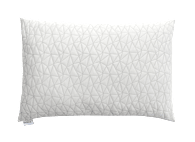
The Coop Sleep Goods The Original pillow is made of shredded memory foam and excels in our tests for support, no matter your size or sleep position. It’s quite versatile, too. The pillow comes with extra foam, allowing you to adjust the filling to your preferred level of comfort. It also keeps its shape well, showing little or no change in height or fluffiness in our resilience tests. Our panel of testers was also impressed by its look and feel. The only area where this pillow falls a bit short is its ability to circulate air effectively; it sleeps slightly warm. The Coop is the only pillow in this roundup that is completely machine-washable.
The PureLux Simply Cool Memory Foam pillow is a dream for side sleepers and almost as dreamy for back sleepers. It offers optimal support for the neck and spine in a highly resilient and breathable package. Made of gel memory foam, this pillow does not retain excessive heat and has cooling properties that will help you maintain an ideal body temperature for rest. Because this is a slab-style memory foam pillow rather than a shredded model, only the cover should be machine-washed. The core should only be spot-cleaned.
The Plank by Brooklyn Bedding Premium Shredded Foam pillow impresses evaluators across the board. It offers top-tier support for both back and side sleepers, and its firmness and height are expected to remain unchanged with use. Because it excels in our breathability assessment and has cooling properties, sleepers can expect a comfortable surface that helps regulate their body temperature throughout the night.
This moderately priced pillow is adjustable, allowing you to add or remove filling and reposition it to suit your needs. “Small and large side sleepers may want to try removing about a quarter of the filling for optimal support,” says Misha Kollontai, the CR engineer who oversees pillow testing. “Back sleepers may want to remove about half of the filling.” This pillow is not machine-washable.
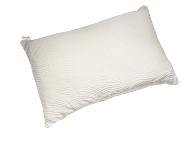
Coop Home Goods is known for its high-quality adjustable fill pillows, and one of the brand’s newest launches is ensuring that reputation stays intact. Made from cross-cut Talalay latex and breathable polyester fibers, the Coop Sleep Goods Adjustable Latex pillow delivers superior comfort and top-notch support for back and side sleepers. Our evaluation find this newcomer to CR’s ratings to be quite resilient and offer solid pressure relief and head support. While the cover of this pillow can be washed, the pillow itself is spot-clean only.

The Sealy Dreamlife collection is one of the brand’s more recent major product launches, and the Sealy Dreamlife pillow in particular is a standout among the brand’s new lineup. Testers find that the pillow provides excellent support for side sleepers and very good support for back sleepers. It also excels in our resilience test and is expected to provide satisfying comfort for most sleepers. Constructed with a memory foam pad and a cooling gel layer, the pillow sleeps cooler and is quite breathable—a selling point if you tend to sleep hot. It has a washable cover, but the interior should be spot cleaned.
How to Care for Your Pillows
Pillows require a bit of maintenance to be kept in good shape. Be sure you know how to wash your pillow. And if you have asthma or a dust mite allergy, consider adding a pillow protector. Regardless of how well you care for your pillows, they need to be replaced regularly, particularly if you have allergies. The Asthma and Allergy Foundation of America recommends replacing pillows every two years. Indoor allergens, such as dust mites, thrive in places that trap moisture, and that includes bedding. For more information about pillows, consult our pillow buying guide, which covers additional factors to consider when shopping.
How CR Tests Pillows
Consumer Reports currently rates more than 75 pillows from widely available brands, each of which has been poked, prodded, and pounded by lab machines. We assess how well each one supports the head and neck of people of various sizes—petite, average, and large/tall—regardless of whether they sleep on their sides or backs. And we use a pressure mat to analyze about 1,600 pressure points, focusing on the contact area between the head and the pillow.
We also evaluate how well pillows retain their shape by placing an evenly distributed 225-pound weight on each one (to simulate the human body) in a room set to 98.6° F (to mimic body heat) for 96 hours. “Some pillows will show considerable changes, but fluffing will bring the pillow back to the exact characteristics it had prior to the test,” Kollontai says. “Some aren’t able to bounce back.” That’s reflected in a lower resilience score.


