Your membership has expired

The payment for your account couldn't be processed or you've canceled your account with us.

Re-activate

2027
Infiniti QX65

EPA MPG: 22 mpg

Infiniti QX65 First Drive

Summary

Introduction

2027 Infiniti QX65 Is Comfortable and Quick, but the Powertrain Is Far From Luxurious

Consumer Reports’ car experts don’t feel it matches up with the best midsized luxury SUVs, such as the BMW X6 and Lexus RX

Overview

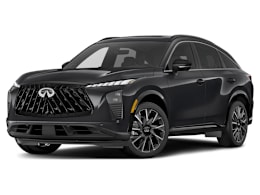
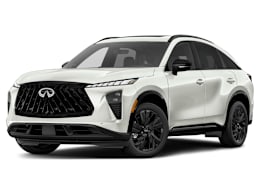
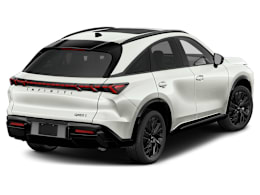
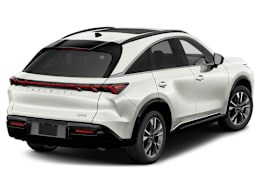
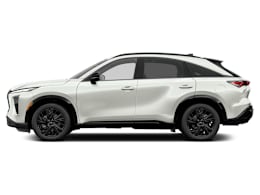
With the addition of the 2027 Infiniti QX65, Nissan’s luxury division now offers just three models: the three-row QX60 midsized SUV, the three-row QX80 large SUV, and the QX65. Infiniti, like its parent Nissan, is in a state of flux, having dropped all its sedans and entry-level SUVs. The sporty, two-row QX65 SUV is a clear attempt to bring new buyers into the fold.

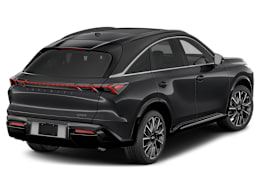
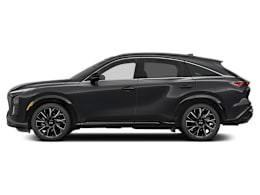
An easy way some automakers enhance a model line is to give it the coupe treatment. This entails lowering the roofline and/or making it more curved toward the rear of the body. The result is a sportier-looking luxury model that often has less usable second-row seating and cargo space. It creates more choices in the showroom, without engineering a truly new vehicle. BMW is widely recognized as the first luxury automaker to embrace this current trend with the 2008 X6, and since then, most of its competitors have followed suit.

The QX65 shares its powertrain with the QX60: a 2.0-liter turbocharged four-cylinder engine that makes “up to 268 hp,” according to Infiniti, paired with a nine-speed automatic transmission. The horsepower number varies depending on the type of fuel used. The 268 hp is with 91-octane premium fuel, while it will make less power on regular 87-octane gas. The base Pure and second-tier Luxe trims of the QX60 are available with front- or all-wheel drive, but the QX65 comes only with AWD.

Prices start at $53,990 for the Luxe trim, with the midtier Sport starting at $55,690. The Autograph version we borrowed from Infiniti has an MSRP of $62,590 and an as-evaluated price of $71,355. The destination charge is $1,545.

This First Drive is our evaluation of the vehicle Infiniti loaned us. Consumer Reports won’t purchase a QX65 to test, so it won’t receive an Overall Score or a road-test score. We anticipate borrowing the recently redesigned three-row QX60 soon to see if it is a better option for consumers than this sportier, hyper-stylized version.

The final assembly point is Smyrna, Tenn.

Impressions

What We Like

Driving position

Our testers, for the most part, found it easy to dial in a comfortable driving position. There’s generous headroom up front, a well-positioned left footrest, and little to no blockage of the instrument panel by the steering wheel. A couple of testers noted that the center console encroached on their right knee space, but the light padding makes it tolerable.

Fancy interior

As far as appearances and craftsmanship go, the QX65’s red quilted seats and dashboard make a bold statement, though it may not appeal to everyone. The Autograph trim also features standard massaging front seats. There are luxurious-looking wood accent panels, which contrast nicely with the red surfaces. The Autograph trim comes with a 20-speaker Klipsch system with Infiniti’s Individual Audio system, which uses head restraint speakers in the front seats to target audio preferences or phone calls to passengers or the driver. However, multiple testers said the speakers didn’t provide any noticeable benefit, with some reporting hearing only a buzzing sound. Overall, while some testers question whether the interior is as rich as the $71,000 sticker price, it makes a very good impression.

Good power if you rev it

The 2.0-liter turbo four-cylinder makes strong power once the driver “gets on it” at higher RPMs. Passing power is more than adequate, whether on the highway or two-lane back roads. The transmission responds promptly and smoothly in normal, light-throttle conditions, especially in third gear and above.

Physical controls

There are a number of normal, physical controls in the QX65, which is refreshing in an era where electrified controls and touch-everything surfaces are the norm. The external door handles are conventional and easy to operate. The temperature knobs for the climate control system are large and have strong detents that let them click into place, making it very clear when an adjustment is made. Our testers also liked the physical steering wheel buttons, standard directional and wiper stalks, and the physical switches for mirror adjustment and side window operation. Finally, as with other Nissan vehicles we’ve recently tested, the infotainment touchscreen responds quickly to inputs.

What We Don't Like

Buzzy engine sound

At the $53,990 base price, the engine noise would be merely frustrating. At $71,355, the sound is awful, infuriating, or, as one tester put it, TERRIBLE. “This engine has never sounded good,” said one tester. “But it seems at its worst so far here in the QX65.”

At low RPMs, there is a highly noticeable buzzy, gargling-like sound that isn’t befitting of a luxury SUV. It’s similar to the sounds from the General Motors turbo four-cylinder engine used in the Chevrolet Traverse and GMC Acadia, which we found uncouth and out of place.

Making it worse, Infiniti has “heightened” the experience with what it calls Active Sound Enhancement, which amplifies engine noise in the cabin. “If this is truly supposed to be a luxury vehicle, and Infiniti has to use this engine, then it should have taken the opposite approach and tried to make it as quiet as possible,” said one of our testers.

The buzzy sound doesn’t compel the driver to push down harder on the accelerator pedal, lest they invoke more of the engine’s audible wrath. Yet that’s the only way to make any usable power (more on that below).

Delayed power then surges

While Infiniti told us that they tuned the powertrain to be more responsive and “sportier” than in the QX60, one tester said, “It seems like all they did was remap the accelerator pedal to be hypersensitive. The tiniest inputs result in way more power than you want.”

As a result, the QX65 doesn’t feel sporty. Rather, it’s just hard to drive smoothly at low speeds. When pulling out of a side street from a stop, rolling into a yield situation, entering a traffic circle, or getting back on the throttle after slowing down, there is a big hesitation followed by a rush of power. In the “auto” drive mode, which is supposed to adjust to conditions and driving style, surges often occur. It’s a bit better in “Sport” mode, which tends to hold on to a lower gear longer, but that shouldn’t be a fix for a problem like this.

Rough shifts

No matter how hard or easy their driving style, all of our testers said that the transmission has harsh upshifts from first to second gear, and that some downshifts between other gears can be rough as well. Combined with the low-speed engine power delays, these rough shifts further hurt the overall driving experience.

Ride comfort

A number of testers commented that the QX65 doesn’t have the ride control to be sporty, nor is it comfortable enough to be luxurious. The QX65 doesn’t feel particularly tied down, with the body pitching fore and aft over undulations, along with some lateral motions that result in side-to-side head toss. Suspension rebound is controlled, so the movements subside relatively quickly, but the result is that there’s a lot of motion going on at all times.

Most imperfections are absorbed well enough to prevent them from being punishing. But the ride is still firm. This odd combination is one reason the QX65 feels neither luxurious nor sporty.

Asymmetrical thinly padded armrests

The center and door armrests are both mounted lower than most of our testers find comfortable, and the center one between the two front seats is on an even lower plane than the one on the driver’s door. This compromises the driving position and reduces front-seat comfort. Furthermore, the padding on both armrests is thin, making them feel quite firm. Perhaps the scant padding is to encourage the driver not to use them, and therefore they won’t notice their asymmetrical positioning.

Touch controls

While these are pretty much standard fare for a current Nissan product (and the Mitsubishi Outlander, which is based on the Nissan Rogue), the haptic buttons for climate functions such as seat heat/cooling and fan speed are odd. It’s nice that they provide feedback when touched, but they require an inordinate amount of force to activate.

The infotainment touchscreen is oddly angled toward the roof, and the interface uses tiny icons, which makes it hard to operate at a glance.

Connectivity

In Nissan vehicles that we’ve recently tested, there have been intermittent connectivity issues with the wireless software on both Android and Apple devices, and the QX65’s system has the same problems. Phones will initially pair without a problem, but won’t reconnect on subsequent drives, requiring the driver to stop and re-pair the phone, either during the drive or at their destination. Is this part of a bigger ploy by automakers to force owners to sign up for their native systems, which can have monthly or yearly fees, and forgo Android Auto and Apple CarPlay? Hmmmm, what do you think, conspiracy theorists?

Mixed Opinions

Raised wireless charge pad

The QX65’s Qi2 wireless charging pad features a raised, circular magnetic pad to keep MagSafe phones and phone cases connected. Since more recent iPhones have this technology built in, they work almost seamlessly, with the pad securing the phone through even the most aggressive turns. Android phones don’t have this feature, although some phone cases perform that function. Unfortunately, the raised pad means that non-MagSafe phones will likely slide around, since they don’t balance on the small pad. Overall, the pad “just works” … except when it doesn’t.

Safety and Driver Assistance

The QX65 comes standard with automatic emergency braking at low and highway speeds, pedestrian detection, blind spot warning, and rear cross traffic warning. It also features lane centering assistance as part of the standard hands-on ProPilot Assist system, which requires that the driver keep their hands on the wheel, and a driver attention alert. Our borrowed QX65 came with the Technology package, which includes the ProPilot Assist 2.1 system. This system enables hands-free driving and includes a driver distraction monitor. This actively monitors the driver to ensure they are looking ahead while using the hands-free system.

A few of our testers weren’t able to use the hands-free driving feature, however. It would engage for a few miles, then deactivate and send a message “HD Mapping Under Maintenance.” So we couldn’t evaluate the automatic lane change capability.

The lane centering assistance system wasn’t the best. It would often let the QX65 swing wide through turns, enough to engage the lane departure warning system. It works well on straighter sections of the roads. However, it was hard to steer collaboratively while the system was engaged, such as when changing lanes. Even when the turn signal was activated, the driver had to give the system a firm tug to put it into standby and allow the lane change. The lane keeping assistance system is fine on straight sections of a road, but unreliable when rounding curves. Finally, the adaptive cruise control was slow to respond when the vehicle in front either accelerated or pulled into a different lane. It would also allow the SUV to approach slow or stopped traffic at a speed too fast for the driver’s comfort. It can be challenging to use the system in stop-and-go traffic or in heavy traffic moving at speed.

Change Vehicle