
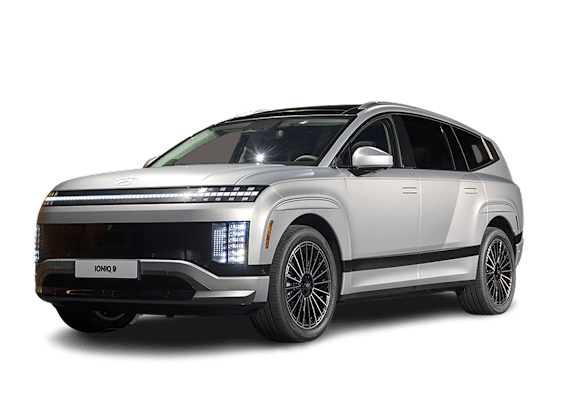
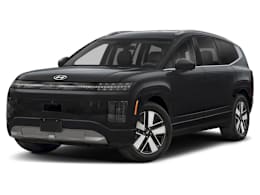
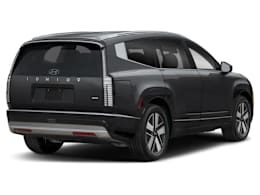
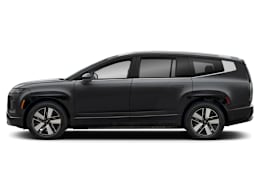


The Ioniq 9 is a sleek, futuristic-looking three-row electric SUV that shares its basic technology and design with the similar Kia EV9. We found it quick and quiet, with a comfortable ride, responsive handling, a long driving range, and a roomy cabin. It achieved an impressively high road-test score, but we can’t recommend it due to its below-average predicted reliability.
If you’re willing to take that risk, the Ioniq 9 is a pleasant SUV with a nicely appointed cabin. Even its most powerful, loaded-up trims offer over 300 miles of driving range, according to the EPA. It has curvier, more aerodynamic styling than its EV9 counterpart, no doubt contributing to its impressive range stats. The number of three-row EV SUVs has increased rapidly in recent years, with several other competitors already on the market, including the Cadillac Vistiq, Lucid Gravity, Rivian R1S, and Volvo EX90. You pay a premium for an all-electric three-row, especially with the loss of federal EV tax incentives, but the Ioniq 9 is easily one of the most compelling options on that list right now.
One of the Ioniq 9’s greatest strengths is its normality. We’re quite fond of its mostly intuitive, conventional control layout, with the one exception of a trendy but frustrating, touch-sensitive panel for the climate controls. The Ioniq 9 feels less like an EV that’s trying to pound you over the head with its EV-ness, and more like a regular, functional family vehicle that just happens to be all-electric.
Despite its spacious interior, the Ioniq 9 wasn’t a perfect fit for everyone due to some awkward design choices and ergonomic issues that affect the driving position, for example. Further, the swoopy styling has a detrimental effect on outward visibility, especially toward the rear of the vehicle.
Still, after our testers spent many months compiling results from more than 50 specific tests and evaluations at Consumer Reports’ 327-acre Auto Test Center, along with lots of miles behind the wheel on public roads, most were incredibly positive about the Ioniq 9. As one tester enthused, “This car is a dreamboat and beats any electric SUV from Rivian or Volvo, not to mention the Kia EV9.”
“I really like it,” said another tester. “It does just about everything well. It has a smooth and strong powertrain, solid driving range, a nice ride, it’s reasonably quiet, and the controls are decent and easy to live with. Even the third-row seat isn't too bad. The styling may be the most polarizing aspect of this vehicle, and could very well be the deciding factor for shoppers between this and the EV9.”
We bought a 2026 Hyundai Ioniq 9 SEL AWD for $68,840—anonymously from an area dealer, as we do with every vehicle we test—for the purpose of this road test review. Our Ioniq 9 was assembled in Ellabell, Georgia. We also borrowed a top-level Ioniq 9 Calligraphy ($77,320 as spec’d) from Hyundai, to help add further flavor to this road test evaluation.
Driving experience
Like most EVs, pressing down on the Ioniq 9’s accelerator pedal brings plenty of smooth, immediate, and nearly silent thrust. Our SEL model has 303 hp from its front and rear electric motors, which give it all-wheel drive. Although its 6-second run from 0 to 60 mph is quicker than many vehicles, that’s slightly slower than other three-row EVs.
It’s a very easy vehicle to drive, with more than adequate punch for everyday driving. “It has enough power to pick up speed and pass people easily on the highway, even when it’s fully loaded with people,” said one tester. Acceleration tapers off somewhat after 50 to 55 mph, but not enough that you’re left wanting too much for power.
We love how easy it is to adjust the Ioniq 9’s regenerative braking system—which slows the vehicle when letting off the accelerator pedal, and sends energy to the battery—with paddles behind the steering wheel. Hyundai’s system is capable of bringing the Ioniq 9 to a full stop without the need to step on the brake pedal (known as “one-pedal driving”), which it does smoothly and predictably when using its maximum-regen “i-Pedal” mode.
The dual-motor all-wheel-drive model we tested managed 315 miles during our 70-mph highway-range test, just five miles shy of its EPA rating. It’s the first non-Tesla EV we’ve tested that comes standard with a NACS charging port, which means drivers can use the widely available Tesla Superchargers without an adapter.
The Ioniq 9’s suspension absorbs bumps fairly well, although we’d stop short of calling it plush. It stays balanced and composed on twisty roads, but take a corner with extra verve and you’ll get noticeable body roll. It has a lighter-feeling, slower steering rack typical for a three-row family hauler, but the steering still feels natural.
At our track, the Ioniq 9’s brakes performed well with short and consistent stops on both dry and wet surfaces. Pedal feel is somewhat soft and some testers found the brakes to feel slightly touchy at lower speeds, but most of us got used to them over time.
We found the cabin pretty quiet, with well-controlled wind and road noise. Whine from the electric motors isn’t quite as silent as some EVs, although it’s mostly only detectable during hard acceleration.
Cabin comfort
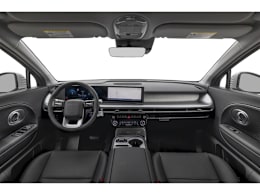
The third-tier SEL trim we tested has an attractive, well-constructed interior that’s more minimalist than it is luxurious. For nearly $70,000, we would have expected more richly padded surfaces and niceties like lined storage areas, which can prevent loose items from rattling around.
Most testers liked the wide, accommodating front seats. There’s plenty of space for the driver, with ample headroom and no right-knee intrusion from the center console, although not everyone could get comfortable. The armrests are too firm, and the steering wheel blocks important information on the driver’s instrument screen when the wheel is tilted down to a lower position.
The second row is very spacious and comfortable, and the wide-opening rear doors make it easy to get in and out. The seats deliver good support and a nice range of adjustability. The third-row seat is adequate for adults for short trips, with decent headroom and good foot space under the second-row seats. Unfortunately, the seat’s low height in relation to the floor results in hardly any underleg support.
Maximum cargo space is competitive with other three-row EV SUVs, at 44.5 cubic feet by our measurements. The Ioniq 9’s small, shallow front trunk (or “frunk”) can hold two backpacks.
Controls and usability
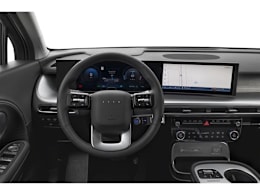
The Ioniq 9’s dashboard features a curved screen integrating dual 12.3-inch displays. One is for the digital driver's instrument screen, and the other is for the infotainment system. We found Hyundai’s touchscreen infotainment system intuitively laid out and easy to use. Wireless Android Auto and Apple CarPlay also come standard—and work quite well—if you’d rather use those interfaces.
Most controls are easy to use, thanks to some physical buttons and knobs, but many climate functions are capacitive-touch “buttons” that can be difficult to tap while driving. They’re also mounted relatively low on the dashboard, taking your eyes even further off the road every time you interact with them. The gear selector is more frustrating to use than it should be. It’s on a thick, low-mounted stalk behind the steering wheel that also includes the start button. While it was easy to get used to the twisting end that selects Drive and Reverse, some testers found the start button difficult to see behind the wheel and awkward to press.
Active safety and driver assistance
Standard active safety and driver assistance features include automatic emergency braking with pedestrian and cyclist detection, automatic emergency braking that operates at highway speeds, blind spot warning, rear cross traffic warning, reverse automatic emergency braking, lane centering assistance (LCA), lane departure warning, lane keeping assistance, adaptive cruise control, and automatic high beams. The Ioniq 9 comes standard with Hyundai's "Highway Driving Assist II" which uses HD mapping to support LCA and is designed for use on limited-access highways. However, LCA itself can be activated on any road that has clear lane markings, not just mapped highways. HDA2 also includes automatic lane change assistance.
We’re happy to see that both a rear occupant alert system and a belt minder come standard. The former is designed to remind the driver—based on rear-door logic—to check the rear seat when the Ioniq 9 is turned off to help prevent children and pets from being unintentionally left behind in the vehicle. The belt minder alerts the driver if a rear passenger unbuckles their seat belt during the trip.
The Ioniq 9 also comes with a Safe Exit Assist system, which can sense if a vehicle or bicycle is approaching from behind or alongside when parked on a city street, and an occupant is about to open a door into traffic.